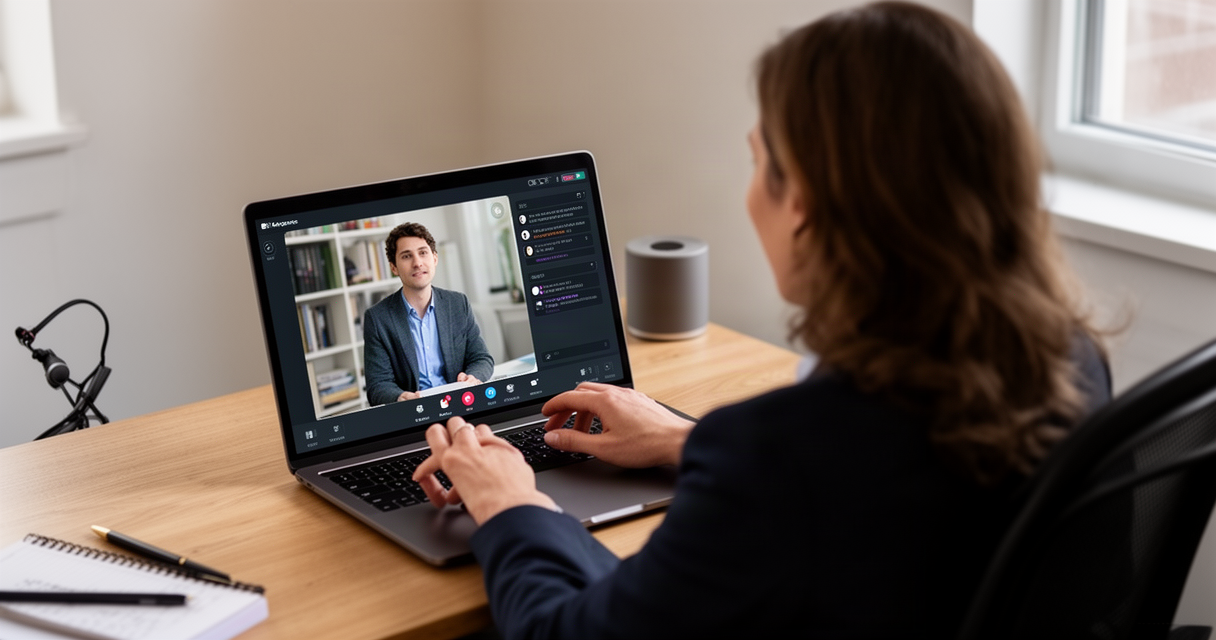
Somewhere in the last two years, “AI interview software” stopped meaning a tool that helps a human run a better interview and started meaning a tool that IS the interview — a bot that calls a candidate, asks the questions, and scores the answers with no human on the line.
For a company hiring 200 warehouse workers a month, that shift might make sense. For a 15-person company hiring three people a year, it can mean paying a subscription that costs more per hire than a recruiter would, while a candidate screenshots the awkward transcript and posts it to a subreddit with 800,000 members.
Most small businesses hiring under roughly 20 people a year do not need a live AI interviewer. The subscription rarely pays for itself at that volume, and the candidate-trust cost is real and documented, not theoretical. If a small business still wants to automate part of hiring, only transparently priced, self-serve tools are worth evaluating — demo-gated enterprise platforms are built for staffing and BPO-scale volume, and the pricing opacity itself is a signal they weren’t built for a small buyer. Plain human interviews over Zoom or phone remain a completely legitimate answer, not a consolation prize.
Getting to that verdict requires separating what “AI interview software” actually contains, because most rankings of these tools don’t bother.
What “AI Interview Software” Actually Means (and What It Doesn’t)
“AI interview software” gets used as a catch-all for three distinct products with three different risk profiles. Lumping them together is how a small business owner ends up comparing the wrong things.
Live AI interviewer bots — Alex (the platform formerly known as Apriora), HeyMilo, and EasyHire fall in this bucket. These tools call or video-chat a candidate directly, run the entire conversation autonomously, and generate a score with no human present during the interview. The candidate is, in a real sense, being interviewed by software.
Async video interview tools — the category HireVue popularized, along with tools like Willo and Spark Hire — work differently. A candidate records themselves answering pre-set questions on their own schedule. A human reviews the recording later. No AI conversation happens in real time; the automation is in scheduling and organizing responses, not in conducting the interview.
AI notetakers sit in on a live, human-to-human conversation and produce a transcript and summary. The human still runs the interview from first question to last. The AI’s job is clerical, not evaluative.
| Category | Who runs the conversation | Example tools | Core risk |
|---|---|---|---|
| Live AI interviewer | The AI, autonomously | Alex/Apriora, HeyMilo, EasyHire | Candidate trust, cost per hire at low volume |
| Async video interview | Candidate records, human reviews | HireVue, Willo, Spark Hire | Still one-sided; some candidate resistance |
| AI notetaker | A human, AI assists | Screenloop-style, Metaview-style | Minimal — human stays in control |
This article is mainly about the first category, because that’s the one raising real ROI and trust questions for a small employer. Most “best AI interview software” lists blur all three together on purpose — it makes the list longer and easier to monetize. That’s a disservice to an owner or office manager trying to make one decision about one hiring process. Even people inside the industry draw this line sharply: a talent-acquisition professional describing a demo of these tools put it flatly on r/recruiting — “NO. Do not do this. There are other ways to use AI as part of your pre screening process but no no no on these chat bots or one way video interviews. Interviewing is supposed to be a conversation between 2 people.”
The ROI Math: At What Hiring Volume Does This Actually Pay Off
The honest way to evaluate any of these tools is to divide the annual cost by the number of interviews actually being run, then compare that per-interview number against what a recruiter, hiring manager, or part-time screener already costs.
Here’s what the pricing looks like across the three most-discussed live AI interviewer tools, as of 2026:
- EasyHire offers a free tier for up to 5 interviews a month, an Entry tier at roughly $35 per job per month (covering about 10 interviews per vacancy), and a Standard tier around $75 per job per month (about 100 interviews per vacancy). This is the most solidly verified pricing of the three — it’s published on EasyHire’s own site and aggregated by G2 — but SaaS pricing shifts, so it’s worth confirming current numbers directly on easyhire.me before budgeting against it.
- Apriora, now operating as Alex (alex.com), reportedly has a starter plan around $30 a month. Beyond that, pricing moves into a demo-gated enterprise flow with no published number. Third-party trackers estimate annual contracts somewhere in the $10,000–$35,000 range, but that figure is a secondhand, reported estimate — not a confirmed vendor price — and it clearly varies by volume and negotiated terms.
- HeyMilo runs pay-as-you-go, reportedly around $8 per interview for the first 100, trending down toward roughly $4–6 per interview on higher-volume fixed contracts. Again, this is an approximate figure aggregated from third-party cost breakdowns, not a quoted vendor price — verify directly with HeyMilo before committing.
Run the math at low volume. A 20-person company hiring three roles a year, doing maybe 15 first-round interviews total, would pay EasyHire’s Entry tier (~$35/job/month) for roughly one to two months per opening — call it $70–$140 per role, or a few hundred dollars a year. That’s not unreasonable on its face. But it still has to beat the alternative: a hiring manager or office manager spending the same 15 half-hour slots on Zoom, which costs nothing beyond time already being paid for.
At Apriora/Alex’s estimated enterprise range, the same 15-interview year would cost somewhere between $650 and $2,300 per interview if the low end of the reported $10k figure applies — a number that only starts to make sense once volume climbs into the hundreds of interviews a year.
A recruiter who has actually piloted these tools framed the volume line clearly on r/recruitinghell: “They work fine if you’re hiring hundreds of warehouse staff or retail associates where the screening is just ‘Can you work nights? Do you have X certification?’ But for professional services, technical, or leadership roles, they fall apart fast. The bots can’t handle nuance, they don’t know how to dig deeper or pivot when an answer isn’t straightforward.”
That distinction matters more than the pricing tier. Most small businesses aren’t screening for “can you lift 50 pounds” — they’re hiring for roles where judgment, tone, and follow-up questions are the entire point of the interview. The tool’s value proposition and the small employer’s actual hiring problem often don’t overlap.
AI is genuinely useful for sourcing and scheduling at any hiring volume — the math specifically breaks down at the decision-making step, when volume is too low to amortize either the subscription cost or the tool’s blunt instincts against complex roles.
Why Small Businesses Are Adopting This Slower Than Everyone Else
The adoption gap between small and large employers on AI-in-HR tools isn’t subtle. Per SHRM’s State of AI in HR 2026 report, as cited by HireTruffle, small employers with 2–99 employees have implemented AI in HR at roughly 33%, compared to roughly 60% at companies with 5,000 or more employees. That citation is secondhand — it comes through HireTruffle’s aggregation rather than a direct read of SHRM’s full report — so treat the exact percentages as directional rather than precise.
The caution isn’t limited to hiring specifically. Per a 2026 Bluevine/Centiment survey of small business owners, as cited by HireTruffle and separately referenced in Bluevine’s own published report, about 78% of small business owners say they don’t fully trust AI to handle even low-level tasks without oversight. Again, this is survey-reported data that hasn’t been independently re-verified here — but the direction is consistent across both sources.
Interviewing sits at an uncomfortable intersection of those two numbers. It’s a high-stakes decision (a bad hire is expensive to unwind) with low tolerance for unsupervised automation — exactly the combination the Bluevine/Centiment data flags as where small owners hold back hardest. A recruiter at a 25-person company described the actual bottleneck on r/recruiting: “We’re a small company, we don’t have HR or a dedicated recruiter who can sift through all these resume’s. Not just that, but I’m not a recruiter either, I have lots of other things on the go… My ideal scenario would be to have someone or something find a top 6 candidates I can interview and make a pick from there.”
That’s a sourcing and screening problem, not a missing-interviewer problem. It tracks with the adoption gap: small businesses aren’t behind the times on AI hiring tools. They’re making a rational call that the downside of a bad hire, a lawsuit, or a viral complaint outweighs the upside of saving a few hours a week.
The Candidate-Trust Problem: Why “AI Interviewing People” Backfires
Bias perception around AI hiring tools is not a fringe concern. Per a 2026 Enhancv survey of 1,066 US job seekers, as cited by HireTruffle, roughly 47.7% agree that AI hiring tools carry bias against age, race, gender, or background, versus about 25.8% who disagree. That’s a secondhand citation and hasn’t been independently re-verified against Enhancv’s full report, but a near-majority of job seekers walking into an AI-run interview already suspicious of it is not a small marketing problem.
Reddit backs that sentiment with specifics, not just percentages. Threads about being screened by a bot with a first name — “Riley,” “Milo,” “Randi” — regularly cross 1,000 to 6,000-plus upvotes in r/recruitinghell. These are individual anecdotes and viral threads, not a scientific sample of every candidate’s opinion, but the volume and consistency of the reaction is itself a hiring-brand signal worth taking seriously.
One candidate’s exchange, quoted directly from r/recruitinghell, captures the tone: “Hello, I’m Riley, a virtual recruiter (…) do you have 5-7 minutes for a quick interview? … Thanks. If I can’t speak to a human being, I’m not interested in this position. Bye.” Another candidate, in a separate thread, put it just as bluntly: “I’m not participating in an AI interview. I wasn’t rude or anything, just a simple two sentence email… You want to use AI to interview people? OK. But I won’t work for a company that does this.”
The resistance isn’t confined to job seekers outside the industry, either. An HR-software professional described walking away from a company that had built its own AI interview tool: “I’m in HR software, and got a recruiter trying to set up an AI interview. I didn’t want to, but I went back to look at the company/position… They made the ai interview software they used. Never noped out of a potential interview so fast.”
A small business’s hiring brand doesn’t have the buffer a large company’s does. A viral thread naming a Fortune 500 company barely registers against everything else said about that brand online. A viral thread naming a 20-person company can define how the next hundred applicants perceive it. AI rejecting qualified candidates through opaque resume filters is already a well-documented frustration. AI conducting the entire interview, with no human on the line, is the version of the absurdity that turns a routine hiring process into a screenshot people share.
If You Still Want to Automate: Self-Serve vs. Demo-Gated Enterprise Tools
For a small business that has genuinely run the volume math and still wants to test automation, pricing structure matters as much as feature set.
EasyHire’s model — free tier, then transparent, published per-job pricing — is structured so a small buyer can evaluate the full cost without a sales call. That self-serve, no-commitment-required structure is the category worth considering for a low-volume employer.
Apriora/Alex publishes a low starter tier but routes everything past it into a “schedule a demo” enterprise flow with no visible pricing. For a small buyer, that’s a specific red flag: it means a meaningful time investment — a discovery call, a follow-up demo, a proposal cycle — before ever learning whether the tool fits the budget at all.
HeyMilo is at least partially transparent with its published pay-as-you-go rate, but the more favorable per-interview pricing kicks in only at fixed-volume contracts of 100 to 1,000-plus interviews a month. That’s staffing-agency or BPO-scale hiring, not the volume a 15- to 50-person company generates in a year.
None of these three is being crowned “best” here — this is a category-level read, not a product endorsement. The point is structural: pricing opacity in a category selling to small buyers is itself informative. A tool built with a five-person hiring team in mind shows its price before asking for a meeting. “Schedule a demo” pricing works fine for a company hiring hundreds a month with a procurement process built to absorb that friction. For a small hiring team, it’s a time cost paid before even learning whether the tool is affordable.
Candidates gaming these same tools with their own AI — reading answers off a screen, running a second device through a live interview — is a related and growing problem, covered separately in the roundup of software built to catch AI-assisted candidates. It’s worth knowing that risk exists in both directions before adopting a live AI interviewer.
What Actually Helps a Small Business at Low Hiring Volume
The AI hiring categories that actually fit low-volume hiring look different from the ones getting the most marketing spend.
Async video interview tools let a hiring manager review candidate answers on a Saturday morning instead of clearing three consecutive Tuesday afternoons for live calls — without needing a live AI conversationalist to run the questioning. The async video interview tools built for small teams comparison covers how those options differ for a team this size.
AI notetakers keep a real person running the conversation while eliminating the manual note-taking and post-interview summary writing. This is the one AI hiring category that draws unprompted praise on Reddit rather than complaints. One recruiter described the actual workflow on r/recruiting: “Don’t automate interviews!! But - to make the interviews easier - use an AI interview notetaker like Screenloop. We use it every interview. It provides a full transcript and then generates summaries of the candidates answers, strengths/weaknesses, and highlights their attributes. We’ve made better hiring decisions and delivered better interviews.” A broader set of these options is covered in AI notetakers that assist a human interviewer instead of replacing them.
Pre-employment assessments — skills tests, work samples, structured scoring rubrics — often predict job fit more reliably than any conversational interview, human or AI, particularly when a role draws a high ratio of applicants to openings. The category is broken down in the guide to pre-employment assessments.
For teams still curious about the live-AI-interviewer category specifically and want it benchmarked against the largest incumbent brand in the space, there’s a full comparison of the leading platform, compared against other AI interview platforms like HireVue.
AI is legitimately useful across sourcing, scheduling, notetaking, and structured assessment. The dangerous part, specifically, is outsourcing the judgment call — the actual conversation and the actual scoring decision — to software with no human oversight in the room.
Our Take
Most small businesses hiring under roughly 20 people a year should skip live AI interviewer bots. The subscription math rarely clears the bar at that volume, and the candidate-trust risk is real and documented across dozens of Reddit threads, not a hypothetical downside a vendor can wave away.
If a business is closer to staffing-agency or BPO-scale hiring volume, self-serve, transparently priced tools — EasyHire being the clearest example of the model — are the only version worth piloting. Demo-gated enterprise platforms deserve the same skepticism applied to any vendor unwilling to show a price before a five-figure decision is already emotionally underway.
Doing plain human interviews over Zoom or phone is not a fallback position. For a company hiring a handful of people a year, it is frequently the better outcome — cheaper, more adaptable to nuance, and immune to the specific reputational risk of a candidate walking away mid-call.
Bias and discrimination risk in AI-assisted screening remains a real, unresolved consideration for any business evaluating these tools, and this article isn’t positioned to settle it. This is not legal advice, and no specific tool discussed here is being asserted as biased or as compliant. A growing patchwork of state and local rules already covers disclosure and bias auditing for automated hiring tools; any business considering one should confirm current requirements in its own jurisdiction and ask the vendor directly about its audit practices before signing anything.
The absurdity underneath all of it is worth sitting with: AI rejecting qualified candidates through a resume filter is already a well-known frustration. A bot named Riley conducting a director-level interview, with no human listening in, is the version of that absurdity that turns a routine hiring process into a headline.
Frequently Asked Questions
Is it legal for a company to have AI interview job candidates?
There’s no single federal standard — instead, a growing patchwork of state and local rules covers disclosure requirements and bias-audit obligations for automated hiring tools, and those rules vary and change. This is not legal advice; businesses should confirm current requirements in their own state or city before deploying a live AI interviewer. Disclosing AI use to candidates upfront is a reasonable baseline practice regardless of what’s strictly mandated.
How much does AI interview software cost for a small business?
Self-serve tools like EasyHire range from free (up to 5 interviews a month) to roughly $35–$75 per open job per month depending on tier. Apriora/Alex has a low-cost starter plan around $30 a month, but its enterprise pricing is demo-gated and reportedly runs into the thousands to tens of thousands per year. HeyMilo is pay-as-you-go around $8 per interview, trending down with volume. All of these figures should be verified directly with the vendor, as of 2026, since SaaS pricing changes.
Do candidates actually mind being interviewed by AI?
Community sentiment on r/recruitinghell and r/recruiting skews strongly negative toward live conversational AI interviewers specifically. Candidates describe hanging up mid-call, refusing to continue, and naming the employer publicly. Reaction is markedly less hostile toward simple async video question tools and toward AI notetakers that support a human interviewer rather than replace one.
What’s the difference between AI interview software and an AI notetaker?
An AI notetaker sits in on a live conversation between a human interviewer and a candidate and produces a transcript and summary — the human still runs the interview from start to finish. A live AI interviewer bot conducts the entire conversation autonomously and generates its own score, with no human present during the call.
At what hiring volume does AI interview software make financial sense?
There’s no single verified threshold, but the subscription and per-interview costs of these tools are structured around recurring, higher-volume hiring — retail, call center, seasonal, or staffing/BPO scale — rather than a handful of hires a year. Businesses hiring under roughly 20 people annually should divide any tool’s cost by their actual interview volume and compare that per-hire number against what a recruiter, hiring manager, or their own time already costs.
The Calendar Invite Still Works
The verdict holds regardless of how the next funding round for these tools gets covered: most small businesses don’t need a live AI interviewer, and if hiring volume genuinely justifies automating part of the process, only a transparently priced, self-serve tool is worth testing. Doing the interview personally remains a completely legitimate choice, not a step behind the market.
Before signing up for or booking a demo of any AI interview tool, divide its cost by actual annual hiring volume and compare that per-hire number against what a recruiter, part-time screener, or existing staff time already costs.
The best interview technology most small businesses will ever need is still a calendar invite and a person who shows up.
References
- EasyHire pricing (free tier, Entry, Standard), aggregated by G2 — https://www.g2.com/products/easyhire-me/pricing
- Apriora/Alex pricing and enterprise estimate, HeroHunt.ai, “Alex (Apriora) Pricing and Alternatives 2026” — https://www.herohunt.ai/blog/alex-apriora-pricing-alternatives-2026/
- HeyMilo pay-as-you-go pricing, AIInterviewAgents.com, “How much does AI interview software cost in 2026?” — https://www.aiinterviewagents.com/blog/ai-interview-software-cost
- SHRM State of AI in HR 2026 (33%/60% adoption), Enhancv bias survey (47.7%/25.8%), and Bluevine/Centiment small business trust survey, all as cited by HireTruffle, “AI hiring tools for small business” — https://www.hiretruffle.com/blog/ai-hiring-tools-small-business
- Bluevine 2026 Small Business AI Trends Report — https://www.bluevine.com/blog/small-business-ai-trends-report-2026
- r/recruitinghell — “Just got my first AI HR screening call, oh dear” thread — https://reddit.com/r/recruitinghell/comments/1mq851o/just_got_my_first_ai_hr_screening_call_oh_dear/
- r/recruiting — “Are there any AI bots to automate interviewing?” thread — https://reddit.com/r/recruiting/comments/1bp9k6c/are_there_any_ai_bots_to_automate_interviewing/
- r/recruitinghell — “Told recruiter no to AI interview” thread — https://reddit.com/r/recruitinghell/comments/1n4yt79/told_recruiter_no_to_ai_interview/
- r/recruiting — “Small company recruitment” thread — https://reddit.com/r/recruiting/comments/1oigt6o/small_company_recruitment/