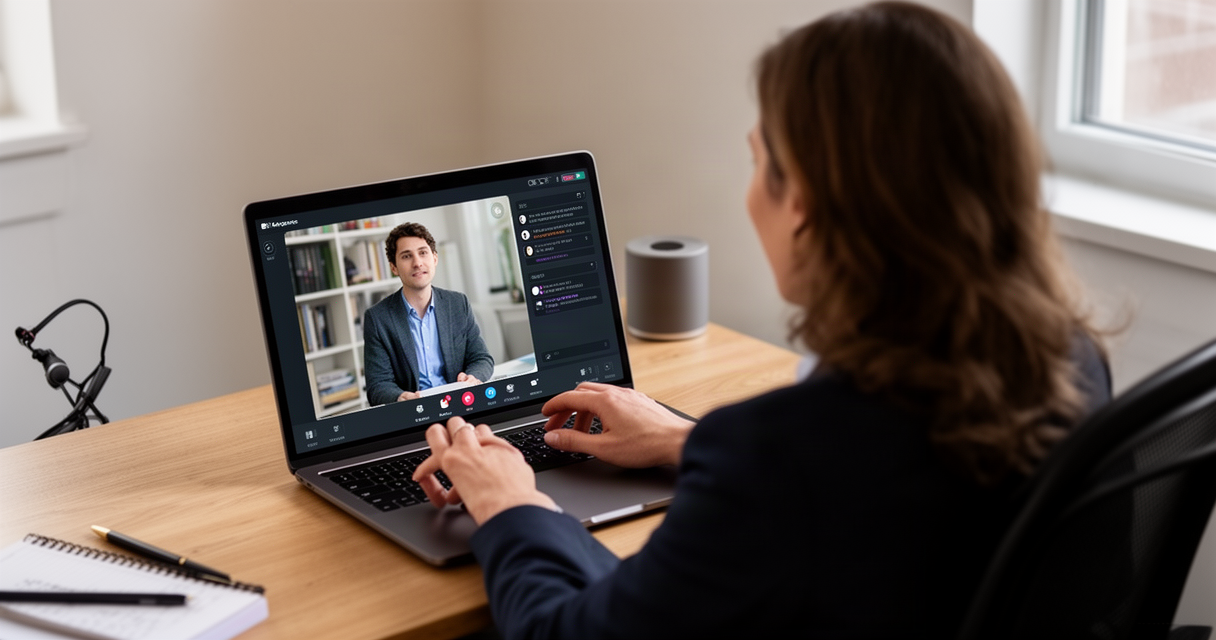
Every time a bot joins your Zoom interview and announces itself to the candidate, you’ve just made the conversation slightly more awkward — and possibly slightly more legally exposed.
Recruiters are doing 10, 20, sometimes 30+ screens a week. Manual notes mean you’re either distracted during the call or spending 15 minutes reconstructing it afterward. The best AI notetaker for recruiters in 2026 solves a real problem. But the generic roundups don’t tell you about the two-party consent laws, the GDPR storage exposure when your tool is a US company processing European candidate data, or the documented bias risks when interviewers review AI summaries instead of their own live impressions.
The quick answer: For most solo recruiters, Fathom’s free tier is the right answer. It gives you unlimited recordings, instant AI summaries, and works across Zoom, Google Meet, and Teams — without a bot joining the call as a separate participant. If you’re doing high-volume work (30+ screens/week) and need ATS scorecard sync, Metaview’s Pro plan at $50/user/month is the recruiting-specific upgrade worth paying for. Fireflies is over-engineered for this use case. BrightHire’s note quality has declined enough that recruiters on Reddit are actively switching away from it.
Here’s how each tool stacks up on the dimensions that actually matter for hiring workflows — plus the legal and ethical landmines the vendor comparison charts never mention.
The Quick Comparison: AI Notetakers for Recruiters at a Glance
| Tool | Free Tier | Paid (starting) | Bot Joins Call? | Recruiting-Specific? | ATS Sync |
|---|---|---|---|---|---|
| Fathom | Unlimited recordings + summaries | $16/mo (Premium) | No (botless) | No | Business tier ($25/user/mo) |
| Metaview | 25 conversations/mo | $50/user/mo (Pro) | Yes | ✅ Yes | Pro tier |
| Fireflies.ai | 800 min storage | $10/seat/mo (annual) | Yes | No | Via Zapier |
| Otter.ai | Limited meetings | $8.49/user/mo (annual) | Yes | No | Zoom native |
| Granola | Limited history | $14/user/mo (Business) | No (botless) | No | No |
| BrightHire | None | Contact sales | Yes | ✅ Yes | ✅ Native (Greenhouse, Lever, Workday) |
| Co-Recruit | Unknown | Not listed publicly | Unknown | ✅ Yes | ✅ Native |
Two tools are worth your time: Fathom and Metaview. Everything else is either over-priced for what most recruiters need or under-built for hiring workflows specifically. The rest of this article explains why.
Fathom Free Tier: What It Actually Gives You (and What’s Missing)
Fathom’s free tier is not the crippled trial most tools ship. It includes unlimited recordings, unlimited transcriptions, instant AI call summaries, clips and playlists, and full search across your call history — with no per-call time limit and no monthly cap. That’s a legitimate tool, not a loss-leader.
The key operational advantage: no bot joins the call. Fathom works via browser extension and records your side of the call. The candidate sees no separate participant, no bot announcement, no awkward admission moment at the start of the screen.
Where the free tier stops: no native ATS scorecard push. If you want transcript notes in Greenhouse or Lever, you’re copying and pasting. That’s 3–5 minutes per interview, which matters at volume.
Fathom Premium at $16/month adds advanced summaries and AI action items. The Team plan at $15/user/month (two-user minimum) adds global search across shared calls and SSO. Business at $25/user/month is where ATS field sync unlocks — but at that price point, you should be comparing it directly against Metaview’s $50/month and asking whether the recruiting-specific features justify the gap.
The one real gap across all Fathom tiers: it doesn’t understand interview context. Every call gets the same generic summary structure. There’s no competency scoring, no candidate assessment template, no structured scorecard output. It’s a great meeting notetaker that happens to work for interviews — not a tool built around how recruiting actually works.
Metaview vs. BrightHire: The Recruiting-Specific Tools Head to Head
If you’ve outgrown Fathom’s free tier, these are the two purpose-built options. They differ more than the feature lists suggest.
Metaview Pro runs $50/user/month billed annually ($60 billed monthly). You get unlimited conversations, custom summary templates per role type, an AI assistant for querying past interviews, and direct ATS sync. Over 4,000 organizations use it. The free tier covers 25 conversations/month with 14-day history — enough to run a real pilot before committing.
BrightHire doesn’t publish pricing. Contact sales, which in enterprise software usually means “expensive enough that we don’t want to scare you off the page.” It includes AI recording and transcription, AI candidate summaries, 1-click ATS scorecard completion for Greenhouse/Lever/Workday, SOC 2 compliance, GDPR compliance, and a third-party bias audit.
On paper, BrightHire wins on compliance. In practice, the picture is worse.
Recruiter u/tcn33 on r/recruiting: “Funny timing, I just moved back to Fathom (from BrightHire) today. The quality of BH notes has rapidly gone downhill over the past few months — from quite comprehensive to completely missing big chunks of conversation.”
Recruiter u/sthsthsth, who used both: “Metaview is the better product by far. Test it with a few sample interviews, the AI model is better at nuance than BrightHire by a lot in my opinion.”
And then there’s the bias angle. u/Natural_Analysis6620, a seasoned technical recruiter focused on equitable hiring, put it directly: “BrightHire is a hard no from me. In trying to ‘streamline’ feedback and analysis, they’ve created major bias risks. Their ‘conversational analytics’ track how much each person talks. They let interviewers rewatch recordings and scrutinize every word a candidate says. Both are serious red flags.”
The verdict: BrightHire has the better compliance story on paper. Metaview has the better product in practice. For most TA teams, Metaview wins. For enterprises with active legal and DEI compliance requirements, BrightHire’s bias audit and SOC 2 posture are real differentiators — but verify the note quality on a trial before you sign a contract.
Platform Compatibility: Which Tools Work on Zoom, Teams, and Google Meet
Most recruiters don’t control which platform the call happens on. The candidate’s preferred video tool, their company setup, or a hiring manager’s calendar invite determines the platform. A notetaker that only works when you’re the host is a liability.
Fathom covers Zoom, Google Meet, and Microsoft Teams via browser extension. You don’t need to be the host. This is the most common point of failure with bot-based tools, and Fathom sidesteps it entirely.
Fireflies supports Zoom, Teams, Meet, and Webex. The catch: the bot participant needs to be admitted to the call. If the candidate is the host and doesn’t admit the bot, you lose the recording. u/sekritagent on r/recruiting described the friction accurately: “Fathom and Otter and shit like that follow you everywhere for Zoom calls and it’s always awkward and annoying trying to get your note taker bot into the call if you aren’t the host.” (Note: this commenter was describing bot-admission friction generally — Fathom’s botless design sidesteps exactly this problem.)
Granola is botless — it records directly from your computer’s system audio, no participant bot required. Works on any platform you’re using. The limitation: Mac-only as of 2026, and it only captures audio from the device running Granola. For most in-house recruiters on MacBooks, this works. For anyone on Windows or needing shared recordings, it doesn’t.
Metaview runs on Zoom, Teams, and Meet using the bot model. Generally gets auto-admitted without friction, but the bot-participant dynamic remains.
If you’re also evaluating which video interview platforms to use for structured interviews, check platform compatibility between your AVI tool and your notetaker before committing to either.
Consent, Legal Risks, and GDPR: What Happens When You Record Without Asking
This is the section no competitor covers. The breezy listicles that say “just tell the candidate you’re recording” are giving bad legal advice.
US law: Ten states require all-party consent to record a conversation — California, Florida, Illinois, Pennsylvania, Maryland, Michigan, Montana, New Hampshire, Oregon, and Washington. Recording a job candidate in California without their consent isn’t a minor technicality. It’s a potential wiretapping violation under the California Invasion of Privacy Act, which carries civil penalties and private right of action.
Verbal consent during the call may not be sufficient documentation in a two-party consent state. You need a record of consent before the recording starts.
GDPR: Recording an interview processes personal data under EU law. Most consumer-grade notetaker companies (Fathom, Fireflies, Otter) store data in the US. Transferring EU candidate data to US servers requires Standard Contractual Clauses or equivalent safeguards. You also need to disclose the recording in the interview invitation — not just verbally at call start — document your lawful basis for processing, and handle deletion requests when candidates ask.
A recruiter based in Germany documented exactly this problem on r/recruiting: “I already received some pushbacks in terms of GDPR concerns, related to recording and storing data at 3rd party companies, most of them based in the US. I am not 100% convinced myself.”
Another commenter in the same thread added: “It’s illegal to record conversations with candidates without their consent in certain jurisdictions. Getting candidates to consent to a recording as the first order of business sounds like not the best way of building a relationship quickly.”
Safe practice: Add a recording disclosure to the calendar invite. State at the start of the call: “I use an AI notetaker to help me capture notes — is that okay with you?” Give candidates the option to decline. If they decline, turn it off.
For EU-facing hiring teams, this is where paying $50/month for a tool with a proper Data Processing Agreement — Metaview and BrightHire both have explicit GDPR postures — is worth the price difference over a free tool with vague US-centric privacy terms. You can find more on the broader AI hiring compliance risks that are landing companies in court.
Does Using an AI Notetaker Make Candidates Uncomfortable?
Most recruiters feel the awkwardness and don’t talk about it. The answer depends on how the tool works.
Bot-based tools (Fireflies, Otter, Metaview, BrightHire) join your call as a visible participant. Candidates see the bot in the grid. Some are fine with it. Some aren’t — and the ones who aren’t tend to be the candidates you most want to attract: senior professionals with options who are already evaluating whether your process respects their time.
u/ManufacturerBig6988 on r/AI_Application captured the candidate-side reaction: “I’m so sick of five different bots joining every single Zoom call. It feels so weird and corporate to have them lurking there. The tools that just natively record the audio through your computer’s mic without adding a creepy silent participant to the grid are way better.”
Botless tools — Fathom and Granola — avoid this entirely. The candidate sees only you. You can disclose that you’re taking AI-assisted notes without the visual friction of a named bot participant staring at them during the conversation.
The counter-argument is real: explicit bot presence makes consent visible and documented. Some compliance teams prefer it precisely because it’s obvious. That’s a legitimate position for regulated industries.
For high-value hires and senior-level searches, skip the notetaker entirely or use botless with verbal disclosure. The relationship cost of an awkward bot moment is higher at that level than the 5 minutes you’d save on notes.
ATS Integration: Getting Notes Into Greenhouse, Ashby, or Lever Without Manual Effort
The time-saving case for paid tools lives almost entirely in this section.
Fathom on free and Premium tiers: manual copy-paste. Business tier ($25/user/month) unlocks CRM field sync — but Fathom’s native integrations lean toward sales CRMs (Salesforce, HubSpot), not recruiting ATS. For Greenhouse or Lever, you’re still doing manual work below the Business tier.
Metaview Pro ($50/month): Direct ATS connection with scorecard sync. The AI assistant can update candidate notes in your ATS after each call. r/recruiting threads consistently name Metaview as the strongest option for Greenhouse and Lever specifically.
BrightHire: “1-click ATS scorecard completion” is the core value proposition — and it’s real when it works. Integrates with Greenhouse, Lever, and Workday. The issue, as noted earlier, is note quality reliability.
Co-Recruit (formerly Quil): Recruiter u/CormackRecruits described the experience: “Seamless integration with my ATS. I use RecruitCRM and as soon as I finish a call, it auto populates the notes directly into the Candidate or Contact file.” Pricing isn’t publicly listed, which is a friction point for evaluation.
Fireflies: ATS integrations exist via Zapier and some native connections, but it’s not built around hiring scorecards. You’re adapting a sales-meeting tool to a recruiting workflow.
u/Junior-Tailor6296 on r/recruiting put the ROI case plainly: “Recruiting-specific tools (Metaview, Noota Talent, BrightHire) actually understand interview context, structured scorecards, candidate summaries, ATS push… saves me 15–20 min per interview easy, pays for itself fast.”
If you’re deciding on your ATS setup at the same time, check which notetaker integrations are native vs. Zapier-dependent before you commit — Zapier integrations break when either side pushes an update.
Free vs. Paid: The Decision Framework for Recruiters
Vendor comparison pages never publish this section because it would correctly tell most users to stay on the free tier.
Under 10 interviews/week: Fathom free is sufficient. Unlimited recordings, good summaries, no time-per-call limit. The 5 minutes of manual notes cleanup per interview costs you less than any subscription.
10–20 interviews/week: Fathom Premium at $16/month is worth considering for advanced summaries and AI action items. Still doesn’t justify a recruiting-specific tool.
20+ interviews/week with ATS requirements: Metaview Pro at $50/month earns its cost. Do the math: 20 interviews/week at 15 minutes of notes each equals 5 hours of notes work weekly. Metaview’s ATS scorecard sync eliminates most of that. At that volume, $50/month is $2.50/hour to automate it. That’s the threshold.
Enterprise teams (10+ recruiters, compliance requirements): BrightHire’s bias audit, SOC 2, and GDPR posture justify the enterprise pricing for regulated industries. Verify current note quality on a trial — don’t sign based on 2023 reviews.
From r/recruiting, u/Own_Battle5956 described the actual transition point: “If you want to go free, use something like Fathom. I switched from Fathom to Metaview, and although I pay for this, after 10 screenings per week, it is paying for itself. It just gives me more than just a transcript, and that helps.”
u/Admirable_Rice_9623 framed it practically: “Depends how often you’re actually using it. If it’s just occasional interviews the free ones are probably enough, but if you’re doing it daily the paid ones start making more sense just for consistency.”
The trap to avoid: paying $50/month for a recruiting-specific tool when you could use Fathom free plus a structured notes template and get 90% of the outcome. Templates don’t require a subscription.
Also worth noting: AI interview prep tools have gotten good enough that candidates are walking into your screens with practiced answers generated by the same AI products you’re using to transcribe them. The symmetry is worth acknowledging.
Frequently Asked Questions
Is a paid AI notetaker actually worth it over the free tier for recruiters?
Depends on volume. Under 15 interviews/week, Fathom free is sufficient — unlimited recordings, solid summaries, no cost. Over 20/week with ATS requirements, Metaview Pro at $50/month pays for itself in scorecard time saved. The calculation: 20 interviews at 15 minutes of notes each equals 5 hours weekly. At $50/month, that’s under $3/hour to automate it.
Which AI notetaker works best for video interviews on Zoom, Teams, and Google Meet?
Fathom is the most consistent across all three platforms via browser extension, no host requirement needed. Metaview supports all three. Granola is botless but Mac-only as of 2026. Fireflies supports all three but requires bot admission to the call — breaks if the candidate is the host.
Do I need candidate consent to use an AI notetaker during a job interview?
Yes, in most jurisdictions. In US all-party consent states — California, Florida, Illinois, Pennsylvania, Maryland, Michigan, Montana, New Hampshire, Oregon, and Washington — recording without all-party consent can be a wiretapping violation. Under GDPR, processing interview recordings as personal data requires a lawful basis and prior disclosure. Best practice: include a recording notice in the calendar invite and verbally confirm at the start of every call.
How do AI notetakers handle confidential interview content and GDPR compliance?
Most consumer-grade tools (Fathom, Otter, Fireflies) store data in the US. EU organizations transferring candidate data to US servers require Standard Contractual Clauses or equivalent safeguards. BrightHire and Metaview both have explicit GDPR compliance postures. Check whether your vendor has a signed Data Processing Agreement (DPA) available — that’s the baseline requirement before deploying any recording tool in an EU hiring context.
Does using an AI notetaker in interviews make candidates uncomfortable or reduce offer acceptance?
Bot-based tools — where a separate participant joins the call — create visible friction, particularly in senior-level or relationship-sensitive hiring. Botless tools like Fathom and Granola avoid this entirely. For high-value hires: disclose recording verbally, use botless tools where possible, and skip the notetaker entirely for C-suite conversations where the relationship cost of a surveillance-feeling moment outweighs the notes benefit.
Can AI-generated interview summaries create bias liability in hiring decisions?
Yes, this is a real and underappreciated risk. When AI summaries become the primary input to hiring decisions, you’ve introduced an algorithmic filtering layer into what should be a human judgment call. BrightHire has been specifically flagged on r/recruiting for conversational analytics that track talk-time ratios and allow interviewers to replay recordings for individual scrutiny — one experienced technical recruiter called both features serious red flags for bias. Use AI notes as memory aids, not as decision inputs. See the broader legal exposure from AI-assisted hiring decisions that’s producing active litigation.
The Verdict
Fathom free tier for most recruiters. Metaview Pro when you need ATS sync at volume. And either way — get your consent disclosure sorted before your next call.
Download Fathom’s browser extension and run it on your next three interviews. If you’re still spending significant time on notes cleanup after a month, that’s your signal to try Metaview’s free tier (25 conversations/month) before paying for anything.
The hiring process already has enough algorithmic filtering that candidates didn’t consent to. At least be transparent about the one tool that actually helps you do your job.