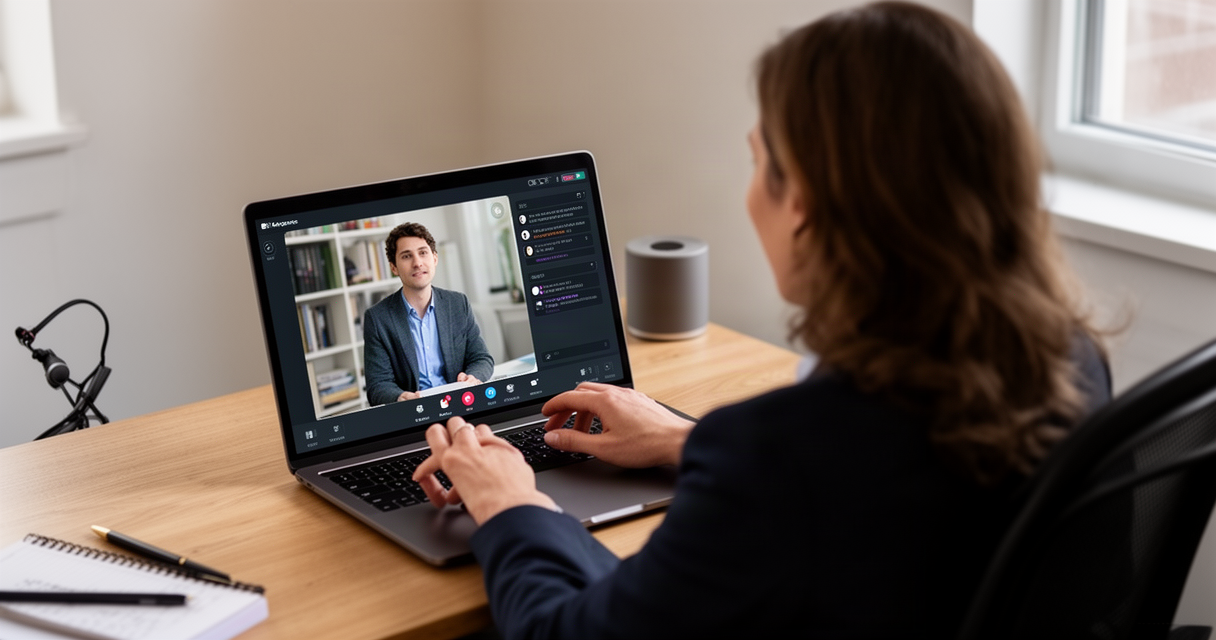
A hiring manager on r/recruiting described spending 45 minutes interviewing a candidate whose answers were suspiciously polished, whose head moved in the same small loop every few seconds, and who never once passed a hand in front of their own face. By the time the team figured out something was wrong, the candidate had already made it to round two.
Interview fraud — deepfaked faces, hired stand-ins, AI-generated answers fed through an earpiece — is no longer a hypothetical. It is showing up in recruiter threads weekly, and vendors have noticed. A new category of AI interview fraud detection software is being sold hard to recruiting teams of every size, often priced as if every team faces the same exposure.
Most 1-5 recruiter teams running live video or phone interviews do not need a dedicated fraud-detection tool yet. A handful of free, boring habits — a live real-time task, targeted follow-up questions, an actual phone call, a reference check, and the fraud flag already built into some ATS platforms — catch most deepfakes and proxy candidates. Dedicated software earns its cost mainly at high volume or in fully-async, global-remote hiring, and even there it needs a human reviewing every flag, not an auto-reject button.
The evidence for both the risk and the response follows.
How Bad Is Candidate Fraud, Really?
The numbers getting quoted around this topic are frequently misused, so it is worth separating what has actually been measured from what is being forecast.
Gartner surveyed roughly 3,000 job candidates in the second quarter of 2025 and found that 6% admitted to some form of interview fraud — impersonation, AI-assisted answers, or misrepresenting who was actually on the call. That is a measured, self-reported figure, not a projection, and it is the most conservative real number in circulation.
The number recruiters actually cite in panic, “1 in 4 candidate profiles will contain material misrepresentation,” is not a current rate at all. Gartner frames it explicitly as a forecast: by 2028. Treating it as today’s baseline overstates the current problem by a wide margin.
Checkr ran its own 2025 “Hiring Hoax” survey of 3,000 hiring managers and got more dramatic self-reported numbers: 35% said someone other than the listed candidate had joined a virtual interview, 31% said they later discovered they had interviewed a fake identity, and 23% estimated losses over $50,000 tied to hiring fraud. These are Checkr’s own survey results — self-reported by hiring managers, not an independently audited industry rate, and Checkr sells fraud-prevention products, which is a reason to read the numbers as directional rather than definitive.
The qualitative signal from recruiters matches the mood if not the precision of the stats. One recruiter on r/recruiting was blunt about the manual burden of catching this by hand: “Manual red-flag checks. Works if you’re screening 5-10 roles at low volume. The signals: LinkedIn URL doesn’t match the name, profile created recently with long work history, email domain doesn’t match, VoIP numbers, resume mirrors the JD word for word… But at 50+ applications per role, you’re burning hours, and you’ll miss patterns that only show up at scale.”
Worth flagging: when a thread about AI interview fraud detection tools goes viral, some of the enthusiasm is not organic. One skeptic on r/recruiting called it out directly: “This post and comment section is a guerrilla advertisement. So many 2 month old and low karma accounts talking about AI products… this is unnatural.” Vendor astroturfing in these threads is itself a reason to weigh community sentiment carefully rather than at face value.
What a Deepfake or Proxy Candidate Actually Looks Like
The clearest documented case comes from Vidoc Security Lab, a security research firm that publicly filmed and disclosed a real interview in 2025 where a candidate used live AI face-swap technology throughout the call. It is not a hypothetical scenario — it is a named, recorded incident.
The tells recruiters report tend to cluster around a few categories. On deepfaked video: looping or repetitive head movement, answers that are too fluent and evenly paced for a live conversation, visible lip-sync lag between mouth movement and audio, and — the most reliable low-tech test — identical, word-for-word answers when the same question is asked twice, minutes apart. One recruiter on r/recruiting described the check that has worked for them: “In the interview with the camera on, do they pass their hand in front of their face? I’ve seen videos of people caught using deep fake, it’s crazy.” Face-swap tools still struggle to render occlusion in real time, which makes the hand-wave test cheap and surprisingly effective.
Proxy candidates — a different person physically standing in for the applicant, or a stand-in interviewing while the real hire does the job later — show a different set of signals: a phone number that turns out to be VoIP, a LinkedIn profile created recently but claiming years of work history, an email domain that does not match the name on the resume, and a resume that mirrors the job description almost line for line.
These fraud patterns show up most often in async video interviewing tools, where a candidate records answers alone with no recruiter watching live. Removing the live human from the loop removes the exact moment most fraud gets caught.
The Boring Methods That Catch Most of It (For Free)
Before evaluating paid tools, it is worth cataloguing what already works without a subscription.
A live, real-time task. Asking a candidate to share their screen and solve a small problem live, or narrate a document out loud in real time, is one of the hardest things to fake convincingly. AI-generated answers to pre-known questions are trivial; improvised, on-the-spot reasoning is not.
Targeted follow-up questions. Asking a candidate to go deeper on something they just said — a specific decision, a specific number, a specific tool they claim to have used — breaks scripted or AI-assisted answers quickly.
An actual phone call. One recruiter on r/recruiting put this plainly: “First line of defense is that rectangle thing on your desk that you use to watch TikTok, also makes phone calls!… Pick up the phone and call the candidate, ask a few random questions… make it a casual non-interview, interview so it’s more difficult to use AI.” A voice-only, unscheduled call is difficult to fake in the moment and costs nothing.
Reference checks, done properly. Calling references directly rather than accepting a written letter closes another gap fraud relies on. Automated reference check software can speed this up for teams doing it at volume, but the underlying method is the same one recruiters have used for decades.
ATS-native fraud flags. Ashby has built fraud detection directly into its applicant tracking system, checking IP location, the age of the candidate’s email and phone number, whether the number is VoIP, and whether it has a history of spam blacklisting. It ships in plans starting around $300 per month — not a standalone purchase, but a feature bundled into a tool many teams already need. A recruiter on r/recruiting summed up the tradeoff: “we’ve been evaluating ATS lately, and Ashby will flag apps it thinks are fraudulent. It’s pretty neat, but unless you’re willing to change ATS, likely not a solution for ya.” Another described how the flag actually behaves: “It looks at a number of indicators including IP address location, age of email and phone number, if someone is using a VOIP phone #, if the number has been associated with spam blacklists in the past. Works pretty well but still requires a human evaluating if they are fraudulent or not.”
That last point matters: even the most integrated version of this technology is designed as a flag for a human to review, not a filter that removes candidates automatically. It is also worth separating this category from a related but different problem. I-9 identity verification software confirms a hired employee is legally who they say they are — a solved, regulated process. Interview fraud detection is trying to catch impersonation earlier, during the interview itself, and it is nowhere near as mature or standardized.
AI Interview Fraud Detection Software vs. Boring Methods: Quick Comparison
| Method | Cost | Setup | Catches | False-Positive Risk | Best For |
|---|---|---|---|---|---|
| Live video + real-time task | Free | None | Most deepfakes, scripted AI answers | Low | Any team doing live interviews |
| ATS-native flags (e.g., Ashby) | Bundled in ATS (~$300/mo+) | Low — built in | Proxy signals: VoIP, IP mismatch, spam-listed numbers | Moderate | Teams already on a fraud-aware ATS |
| Reference checks | Free–low cost | Low | Fabricated identity, resume fraud | Low | All hiring, any volume |
| Dedicated deepfake/proxy detection software | $/mo, often volume-priced | Moderate–high | Real-time face-swap, voice cloning at scale | Uncertain — vendor claims largely unaudited | High-volume or fully-async, global-remote hiring |
Where AI Interview Fraud Detection Software Actually Earns Its Cost
The manual-checks approach breaks down exactly where the recruiter quoted earlier said it would: at 50 or more applications per role, checking LinkedIn URLs, email domains, and profile ages by hand is not sustainable, and pattern-level fraud that only shows up across dozens of applications gets missed entirely by a human scanning one resume at a time.
Fully-async, one-way video interviewing is the second real case. If no recruiter ever talks to the candidate live — no phone screen, no real-time task — there is no natural moment where a deepfake or scripted answer gets caught by instinct. That is when a dedicated detection layer is filling a gap that process alone cannot.
Global-remote hiring is the third. Teams sourcing across time zones and borders, where a live call with every applicant is impractical and identity verification standards vary by country, face more of the proxy-candidate and stand-in-interview pattern that manual checks were designed to catch face-to-face.
Even in those cases, marketing claims need a discount applied. Vendors advertise detection accuracy up to 97% — an unaudited, vendor-reported marketing figure. Independent testing by CSIRO and Sungkyunkwan University found leading deepfake detectors dropped to around 69% accuracy once tested outside controlled lab conditions, on real-world video with normal compression, lighting, and connection quality. A 28-point gap between the marketing claim and independent testing is the number that should shape any purchase decision, not the number on the vendor’s homepage.
The False-Positive and Bias Risk Nobody Selling This Tells You
The same signals used to flag fraud — an unusual accent, a non-native English pattern, a VoIP number, a remote or rural location — are also disproportionately common among legitimate candidates: immigrants, non-native speakers, and people who cannot afford a traditional landline or corporate email domain. A detection system tuned to flag “unusual” patterns will flag real candidates for reasons that have nothing to do with fraud.
This is not a hypothetical concern inside the recruiting community. One recruiter on r/recruiting pushed back hard on the idea of using accent as a signal at all: “Some of the real ones will ghost at the video intro too. And I’m not sure wrong accent is accurate and to be blunt basically racist to use that as signal.” A candidate on the same forum described the cost of that kind of screening from the receiving end: “Yeah, I ditch this kind of nonsense before I even apply because I’m nonwhite. You need to find a way to do this that respects the dignity of candidates, not forcing them to grovel.”
There is a legal precedent worth understanding, though it applies to a broader category than fraud detection specifically. AI hiring tools already facing bias lawsuits include Workday, where a judge denied a motion to dismiss a collective action alleging its AI screening tools filtered candidates by race, age, and disability. Eightfold AI faces a class action, filed in January 2026, over algorithmic candidate scoring applied before any human review. HireVue faced a formal ACLU complaint alleging its AI interview analysis performed worse for non-white applicants and candidates with different dialects or accents.
None of these three cases are about deepfake or proxy detection specifically — they are about AI making or shaping hiring decisions generally. But the underlying pattern is the same one showing up in fraud-detection marketing: algorithmic systems trained on limited data treating demographic and accessibility differences as anomalies. Reviewing the details at AI hiring tools already facing bias lawsuits is worth the time before signing a contract for anything that scores a candidate automatically.
Our Take: Who Should Buy This, Who Shouldn’t Yet
Buy dedicated fraud-detection software if the team is screening 50 or more applicants per role, running fully-async one-way video interviews with no live human touchpoint, or hiring globally in ways that make a live call with every candidate impractical. In those conditions, the manual-checks method genuinely breaks down, and a dedicated layer is closing a real gap rather than solving a problem that does not exist yet.
Do not buy it yet if the team is 1-5 recruiters running live video or phone interviews for most roles. That process already contains the moments — a real-time task, a follow-up question, an unscheduled phone call — where deepfakes and scripted answers get caught by instinct. The money is better spent tightening that process than adding a subscription for a threat the process already covers.
If a purchase does happen, three conditions should be non-negotiable. Demand the vendor’s precision and recall numbers on a population that resembles the actual candidate pool, not a lab benchmark. Keep a human reviewing every single flag — never auto-reject based on a fraud score alone. And before adding a new tool, audit the async video interviewing tools already in the hiring process, since that is the layer where most of this fraud is actually entering the funnel.
Frequently Asked Questions
How common is candidate fraud right now?
Gartner’s 2Q25 survey of roughly 3,000 candidates found 6% admitted to some form of interview fraud — that is the most reliable current, measured figure available. The often-cited “1 in 4 by 2028” statistic is a forecast, not today’s rate.
Can AI reliably detect deepfakes or proxy candidates on video?
Independent testing found leading detectors accurate around 69% outside lab conditions, well below the up-to-97% figures in vendor marketing. Detection tools are a useful flag, not a reliable verdict on their own.
What are the warning signs of interview fraud?
Looping head movement, unusually fluent or evenly paced answers, lip-sync lag, identical answers to a repeated question, and failing to pass a hand in front of the face are common deepfake tells. VoIP numbers, recently created profiles with long claimed work histories, and resumes that mirror the job posting word for word suggest a proxy candidate.
Do small teams need dedicated software, or do manual methods catch most of it?
For teams doing live video or phone interviews at low-to-moderate volume, manual methods — a real-time task, follow-up questions, a phone call, reference checks — catch most fraud attempts for free. Dedicated software earns its cost mainly at high volume or in fully-async, global-remote hiring.
What is the false-positive risk with fraud-detection tools?
Signals like unusual accents, VoIP numbers, and remote locations correlate with fraud but also with legitimate candidates from different backgrounds or with less access to traditional infrastructure. Related AI hiring-decision tools already face active bias litigation, which is a reason to keep a human reviewing every flag rather than automating rejection.
Small Teams Should Fix Process Before Buying Software
Candidate fraud is real, but the size of the problem for most small recruiting teams is smaller than the marketing around it suggests. A live task, a real phone call, a reference check, and — where available — an ATS-native flag catch the overwhelming majority of deepfakes and proxy candidates without a new line item on the budget.
The teams that need dedicated detection software are the ones whose process has already removed the human moments where fraud gets caught: high volume, fully async, or fully global. Everyone else should fix the interview process first and revisit the tools once that gap actually shows up.
References
- Gartner — 2Q25 candidate fraud survey (approx. 3,000 candidates, 6% admitted interview fraud) and 2028 projection (“1 in 4 candidate profiles”); the 2028 figure is a forward-looking projection, not a current rate.
- Checkr — 2025 “Hiring Hoax” survey of 3,000 hiring managers (35% proxy interview, 31% fake identity, 23% >$50k loss); self-reported vendor survey data.
- CSIRO / Sungkyunkwan University — real-world deepfake detector accuracy testing (approx. 69% outside lab conditions), via secondary reporting.
- Ashby — native ATS-integrated fraud-detection feature announcement.
- Workday — FEHA collective action over AI screening bias allegations (motion to dismiss denied), Mobley v. Workday.
- Eightfold AI — class action (filed January 2026) over algorithmic candidate scoring.
- HireVue — ACLU complaint alleging biased AI interview analysis for non-white applicants and different dialects/accents.
- Vidoc Security Lab — 2025 documented case of live AI face-swap used in a real interview. 9-14. r/recruiting — threads on manual red-flag checks, Ashby’s native fraud flag, phone-screen defense, accent-as-signal false-positive risk and candidate dignity, the hand-wave deepfake test, and astroturfing in AI fraud-detection discussions.
Note: Gartner and Checkr figures are self-reported survey data (the 2028 Gartner figure is a projection); vendor “up to 97% accuracy” claims are unaudited marketing. The cited bias lawsuits concern AI hiring-decision tools generally, not deepfake-detection tools specifically. Verify current figures and product features directly before purchasing.