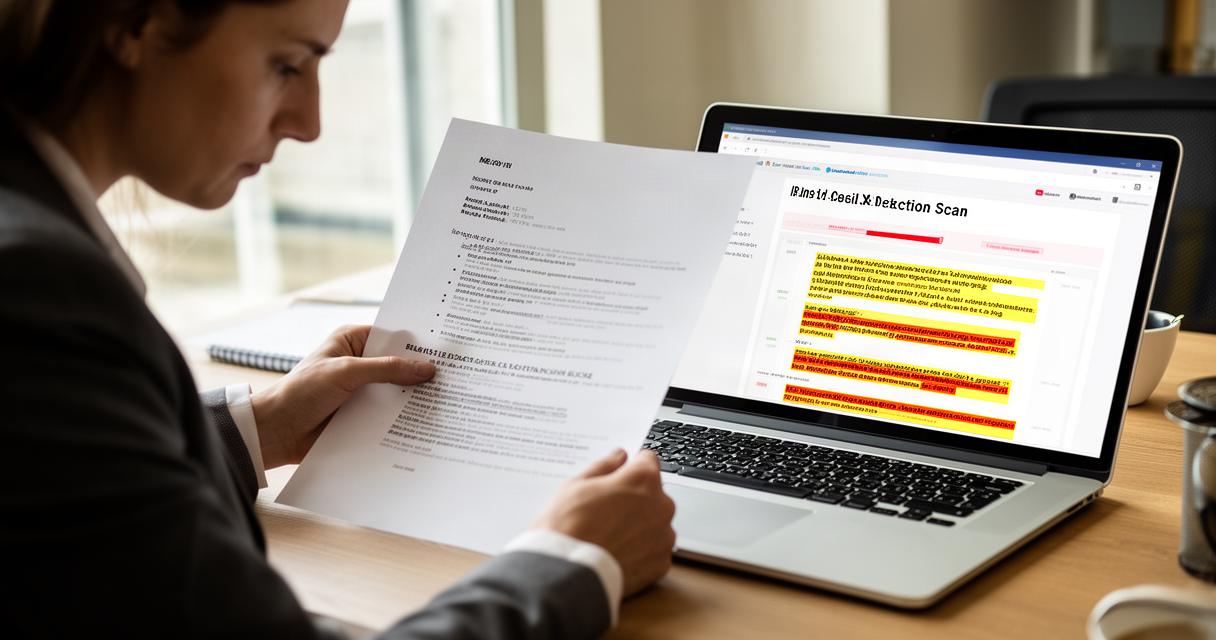
“Run it through an AI detector” has become standard advice in recruiting circles over the past two years. Almost nobody stopped to ask whether the detector is right.
The stakes are not abstract. Auto-rejecting a candidate on a detection score risks cutting the best applicant in the pool — the research shows non-native English speakers and precise, formal writers get flagged at disproportionately higher rates than anyone else. It also risks disparate-impact liability under federal and state law, which does not care whether “the algorithm did it.”
The quick answer: GPTZero is the most purpose-built tool for recruiters, with batch CV scanning, native resume file support, and team seats. Originality.ai posts the strongest independent accuracy numbers of any detector tested. But every tool in this roundup has a documented false-positive problem, which makes a detection score useful as a conversation-starter and reckless as an auto-reject trigger.
The comparison, the research behind it, and what to actually do with a flagged resume follow below.
Best AI Resume Detector Tools for Recruiters — Compared
| Tool | Entry price / team tier | Vendor-claimed accuracy vs. independent benchmark | Recruiter features | Best for |
|---|---|---|---|---|
| GPTZero | Essential $14.99/mo, Premium $23.99/mo, Professional $45.99/mo (250-file batch + API) | Markets high-90s accuracy; not independently isolated in the UF benchmark, but subject to the same cross-detector false-positive pattern documented by Stanford | Dedicated recruiter landing page, batch CV upload (PDF/DOCX/TXT), shared team credits | Recruiters running dedicated resume-screening batches |
| Originality.ai | Base $14.95/mo (2,000 credits), Pro $179/mo | Claims 99%+; independently benchmarked at 97.5% mean accuracy on the University of Florida academic test set | Plagiarism + fact-check layer, credit/word-based pricing, no resume-specific ATS batch mode | Agencies that already run content-verification workflows and screen resumes as a side use |
| Copyleaks | Free tier, then approx. $10.99-$19.99/mo; enterprise priced per-scan | Vendor claims high-90s; not separately isolated in the UF benchmark | Strongest ATS/HRIS API integration story of the group, built to scale to high applicant volume | High-volume corporate TA teams needing pipeline integration |
| Winston AI | Essential $18/mo, Advanced $29/mo, Elite $49/mo | Markets 99.98% accuracy; independently benchmarked at 75.9% mean accuracy on the same UF academic set | Mid-tier feature set, cheaper entry point than GPTZero or Copyleaks | Small teams wanting a cheap secondary check, not a primary decision tool |
| Sapling | Pro $12/mo (with a free tier), API $0.005 per 1,000 words | Vendor claims not independently isolated in available benchmarks | Thin recruiter-specific tooling; built more for content teams | Budget-constrained solo recruiters who want a rough signal, nothing more |
The gap in that middle column is the story of this entire category. Vendors advertise numbers in the high 90s. The one independent academic benchmark available — the UF test comparing Winston AI and Originality.ai on the same document set — found Winston’s real accuracy at 75.9%, roughly 24 points below its own 99.98% marketing claim, per fast.io’s 2026 review (checked September 7, 2026). Originality.ai held up closest to its own marketing at 97.5%. No other tool in this table has been put through an equivalent independent test.
GPTZero — Built for Recruiters, Not Retrofitted
GPTZero is the only major detector in this list with a landing page built specifically for recruiters, and the product design follows through on that positioning. It accepts direct resume uploads in PDF, DOCX, and TXT — no copy-pasting text out of a PDF and losing formatting. Team plans share a pooled credit balance, and the Professional tier at $45.99 per month adds 250-file batch processing plus API access, which is the tier that matters for anyone screening more than a handful of resumes a week.
That purpose-built design earns GPTZero the top spot in this ranking. But it does not exempt the tool from the category’s core weakness.
Resumes are short, formulaic documents. Bullet points. Action verbs. Quantified achievements in a narrow band of phrasing that career coaches and templates have been pushing for a decade. That is exactly the kind of compressed, pattern-heavy content that AI detectors — trained to spot statistical regularity — struggle with most. A resume that looks “too clean” reads to a detector almost identically whether a human polished it with years of practice or a language model generated it in ten seconds.
Originality.ai — The Strongest Accuracy Numbers, Priced for Agencies
Originality.ai carries the best independent accuracy result of any tool tested here: 97.5% mean accuracy on the UF benchmark, closer to its own marketing claims than any competitor, per fast.io’s review. It also layers in plagiarism detection and fact-checking, features built for content teams verifying published work, not recruiters scanning applicant PDFs.
The pricing structure reflects that origin. Base tier runs $14.95 per month for 2,000 credits; Pro jumps to $179 per month. Both are structured around word or credit volume, the unit that makes sense for a content agency running thousands of articles through the tool, not the unit that makes sense for a recruiter running fifty resumes a week.
Originality.ai has no resume-specific ATS batch mode. A recruiting team buying it purely to screen resumes ends up paying for a plagiarism and fact-check layer it will never touch, in service of an accuracy number that is genuinely the strongest in the category. The tool earns its place in this ranking on accuracy alone — it just was not built for this job.
Copyleaks, Winston AI, and the HR-Specific Niche Tools (Sapling, It’s AI, aicheckr.io, CloudApper)
Copyleaks has the strongest ATS/HRIS integration story of the group. The API is built to scale into high-volume applicant tracking pipelines, which is the differentiator for corporate talent acquisition teams running thousands of applications through a system rather than manually uploading files one at a time. Pricing runs from a free tier through roughly $10.99-$19.99 per month, with enterprise volume priced per scan.
Winston AI sits in the middle of the pack on independent accuracy — 75.9% mean accuracy on the UF benchmark against a 99.98% vendor claim, the largest gap of any tool independently tested in this roundup. It undercuts GPTZero and Copyleaks on price, at $18 to $49 per month depending on tier, which makes it a reasonable secondary check but a poor choice as a primary signal.
Sapling is the cheapest entry point in the category at $12 per month for the Pro tier, with a free tier and API access priced at $0.005 per 1,000 words. Recruiter-specific features are thin — it was built for general content verification, not resume screening, and it shows.
It’s AI markets directly at recruiters and offers batch CV scanning with shareable reports, positioning itself as a lighter-weight alternative to GPTZero for teams that want the recruiter framing without the higher price tiers.
aicheckr.io is free and runs sentence-level detection, making it more candidate-facing than recruiter-facing — a tool someone might run on their own resume before submitting it, rather than one a TA team would deploy at scale.
CloudApper deserves a separate flag: it is not a standalone AI detector. It is an AI recruiter and screening ATS that includes “cheating detection” as one feature among many. Recruiters shopping specifically for a resume-detection tool who land on CloudApper are buying a different product category — a full screening platform, not a dedicated detector — and should not confuse the two.
The Research Every Recruiter Using These Tools Needs to See First
A 2023 Stanford study — Liang, Yuksekgonul, Mao, Wu, and Zou, available at arxiv.org/pdf/2304.02819 — ran seven GPT detectors against real TOEFL essays written by non-native English speakers. The average false-positive rate across all seven detectors was 61.3%. Nearly 1 in 5 essays — 19.8% — were unanimously misflagged as AI-generated by all seven tools simultaneously.
Essays written by native English speakers, run through the same seven detectors, were classified correctly nearly every time. The bias was not random noise. It was systematic, and it penalized exactly the writing patterns — simpler sentence structure, more formulaic phrasing, fewer idioms — that non-native speakers produce when writing in a second language under time pressure.
A resume is that same kind of writing: short, formulaic, optimized for clarity over stylistic flourish. The Stanford paper studied essays, not resumes specifically, but the underlying mechanism — detectors penalizing precise, formal, low-variance writing — transfers directly to applicant screening. Vendor benchmarks are typically run on curated test sets designed to make the tool look good. Real-world accuracy, across the tools where independent testing exists, runs 10 to 15 points below what the marketing page claims.
Even QuillBot, which sells its own AI detector, states plainly on its own product page: “Never rely on an AI detector alone when making decisions that could impact someone’s career or academic standing.” That is a vendor’s own disclaimer, not a critic’s.
Is It Even Legal to Reject a Candidate Over an AI-Detection Score?
The legal exposure here is not hypothetical. Title VII of the Civil Rights Act applies to hiring outcomes regardless of intent — a screening tool does not need to be designed to discriminate to create disparate-impact liability, it only needs to produce a discriminatory result. The EEOC’s four-fifths rule is the standard test: if one group’s selection rate falls below 80% of another group’s rate, the burden shifts to the employer to demonstrate the practice is a business necessity, per the American Bar Association’s April 2024 analysis. Given that AI detectors are documented to flag non-native English writing at dramatically higher rates, a policy of rejecting flagged resumes is a plausible disparate-impact claim waiting to happen.
New York City has already codified the response. Local Law 144 requires any employer using an automated employment decision tool — a category that explicitly includes resume parsing, ranking, and scoring tools — to commission an annual independent bias audit, publish the results publicly, and give candidates 10 business days’ notice before the tool is used on their application, according to Pivot Point Security’s compliance guidance. Penalties run from $500 up to $1,500 per day of noncompliance.
None of this is avoidable by outsourcing the decision to a vendor. Employers remain legally liable for the outcomes of tools they deploy. “The algorithm did it” has never been a defense, and detector vendors do not indemnify their customers against the discrimination claims their tools’ error rates can produce.
Our Take: Use the Score to Start a Conversation, Never to End One
If a recruiting team is going to use a detector at all, GPTZero is the stronger fit for a dedicated resume-screening workflow, and Originality.ai is the better call for a team that already needs its accuracy for other content-verification work. That much is a straightforward recommendation grounded in the comparison above.
The recommendation that matters more: no detection score should trigger an automatic rejection, from any tool in this category, ever. A flag should trigger one thing — a specific, unscripted follow-up question in an interview that only someone who actually did the work can answer convincingly. “Walk me through how you approached this project” surfaces the truth in ninety seconds. A detection percentage does not.
The counter-argument deserves a fair hearing. A talent acquisition leader with 15 years of experience put it bluntly on r/resumes: “I’ve been a leader in Talent Acquisition for 15 years and can not imagine an employer wasting cycles and resources on AI detection for resumes. AI detection for resumes simply isn’t a thing.” Recruiters weighing whether this category is worth their time at all should take that seriously — the practice may not be widespread yet, which is precisely why the ones adopting it early are setting a precedent worth getting right.
Where it is happening, the community evidence is consistent and specific. One thread on r/recruiting described a colleague’s practice directly: “The AI resume thing is tricky because yeah, everyone’s using ChatGPT now to polish their bullets… If she’s declining everyone who got help with formatting, she’s probably tossing half the qualified people.” Another commenter on r/resumes connected the bias to who writes precisely: “The AIs have been trained using idealized, almost perfect, writing samples from professional writers. So of course, if you have spend years learning how to write… the AI detector will say your cover letter is written by an AI.” A commenter on a YouTube AI-detector test video made the same point about mechanism: “AI detectors are essentially pattern matchers, not ‘truth tellers’. In non-fiction, where the pattern of human speech is naturally more rigid, factual, and formal, it becomes nearly impossible for a mathematical formula to distinguish between a person being precise and a machine being statistical.”
The real horror story in this category is not a candidate who used ChatGPT to sharpen a bullet point. It is an ATS or a hiring manager quietly auto-rejecting on a flag nobody reviewed, filtering out the strongest applicants for the crime of writing clearly. Teams evaluating whether their screening stack has this exposure at all should start with AI resume screening software built for the full pipeline, not a bolt-on detector, and pair any AI-detection layer with AI bias audit tools before rolling it out company-wide.
Frequently Asked Questions
Can recruiters actually tell if a resume was written by AI?
Not reliably. Detectors flag statistical patterns associated with AI-generated text, but resumes are short and formulaic by design, which produces the same patterns in human-written documents. The Stanford study found detectors misclassify a majority of non-AI text from certain writer populations, and no tool in this roundup claims resume-specific validation independent of general-purpose text testing.
Do AI resume detectors have false positives, and who do they hurt most?
Yes, and the harm is not evenly distributed. Stanford’s 2023 research found a 61.3% average false-positive rate on TOEFL essays by non-native English speakers, with nearly 20% unanimously misflagged by all seven detectors tested. Precise, formal writers and neurodivergent applicants are also disproportionately affected, according to community reports on r/resumes.
Should you auto-reject a candidate whose resume gets flagged as AI-generated?
No. A flag should prompt a targeted follow-up question in an interview, not an automatic rejection. Given the documented false-positive rates and the disparate-impact exposure under Title VII, auto-rejection on a detection score alone creates both a hiring-quality risk and a legal one.
Which AI content detector is most accurate for screening job applications?
Among tools independently benchmarked, Originality.ai posted the strongest result at 97.5% mean accuracy on the University of Florida academic test set, well ahead of Winston AI’s 75.9% on the same set. No detector has been independently benchmarked specifically on resume text, so even the strongest score should be treated as directional, not conclusive.
Is it even legal to reject a candidate for using AI to write their resume?
It depends on how the rejection happens. Rejecting based on a documented, non-discriminatory business reason is legal. Rejecting via an automated tool’s score, when that tool demonstrably flags certain groups at higher rates, risks a Title VII disparate-impact claim, and in New York City triggers Local Law 144’s audit, disclosure, and notice requirements regardless of intent.
The Detector Score Was Never the Test
GPTZero leads this category on fit for a dedicated recruiter workflow. Originality.ai leads on independent accuracy. Every tool in this roundup, including both of those, is wrong often enough — and unevenly enough across who it is wrong about — that none of them should make a reject decision alone.
The practical move for any team considering this category: pilot a detector for 30 days as an internal flag-for-review signal only, never a rejection trigger. Track who gets flagged against who ultimately gets hired, and look hard at whether the flagged group skews toward non-native English writers or unusually polished applicants. Teams operating in New York City need the Local Law 144 bias audit completed before the tool touches a single real application. Teams already running AI interview tools alongside detection should also check whether AI interview software is worth it and pair any of this with AI interview fraud detection tools built for that specific problem rather than repurposed text detectors.
The resume was never the test. The interview was always the test — the detector just gives you a worse excuse to skip it.
References
- r/resumes — “AI detectors are saying my resume is 100% AI” thread — https://reddit.com/r/resumes/comments/1g8yxhg/ai_detectors_are_saying_my_resume_is_100_ai/
- r/resumes — “Is AI ruining people’s chances to get professional [jobs]” thread — https://reddit.com/r/resumes/comments/1iyyg70/is_ai_ruining_peoples_chances_to_get_professional/
- r/recruiting — “AI resume” thread — https://reddit.com/r/recruiting/comments/1p4pyoj/ai_resume/
- YouTube — comment on an AI-detector test video — https://www.youtube.com/watch?v=tiUTCDDFCT4
- Product Hunt — GPTZero launch discussion — https://www.producthunt.com/products/gptzero/launches/gptzero
- Liang, Yuksekgonul, Mao, Wu, Zou (Stanford, 2023) — “GPT detectors are biased against non-native English writers” — https://arxiv.org/pdf/2304.02819
- fast.io — Winston AI Detector Review 2026 (UF benchmark data) — https://fast.io/resources/winston-ai-detector-review-2026 (checked September 7, 2026)
- Pivot Point Security — NYC Local Law 144 compliance guidance — https://pivotpointsecurity.com (checked September 7, 2026)
- American Bar Association, Business Law Today — Title VII disparate impact and the four-fifths rule, April 2024 — https://americanbar.org (checked September 7, 2026)
- QuillBot — AI Content Detector product page disclaimer — https://quillbot.com/ai-content-detector (checked September 7, 2026)
- Originality.ai — official pricing page — https://originality.ai (checked September 7, 2026)
- GPTZero — official pricing page — https://gptzero.me (checked September 7, 2026)
- Copyleaks — official pricing page — https://copyleaks.com (checked September 7, 2026)
- Winston AI — official pricing page — https://gowinston.ai (checked September 7, 2026)
- Sapling — official pricing page — https://sapling.ai (checked September 7, 2026)