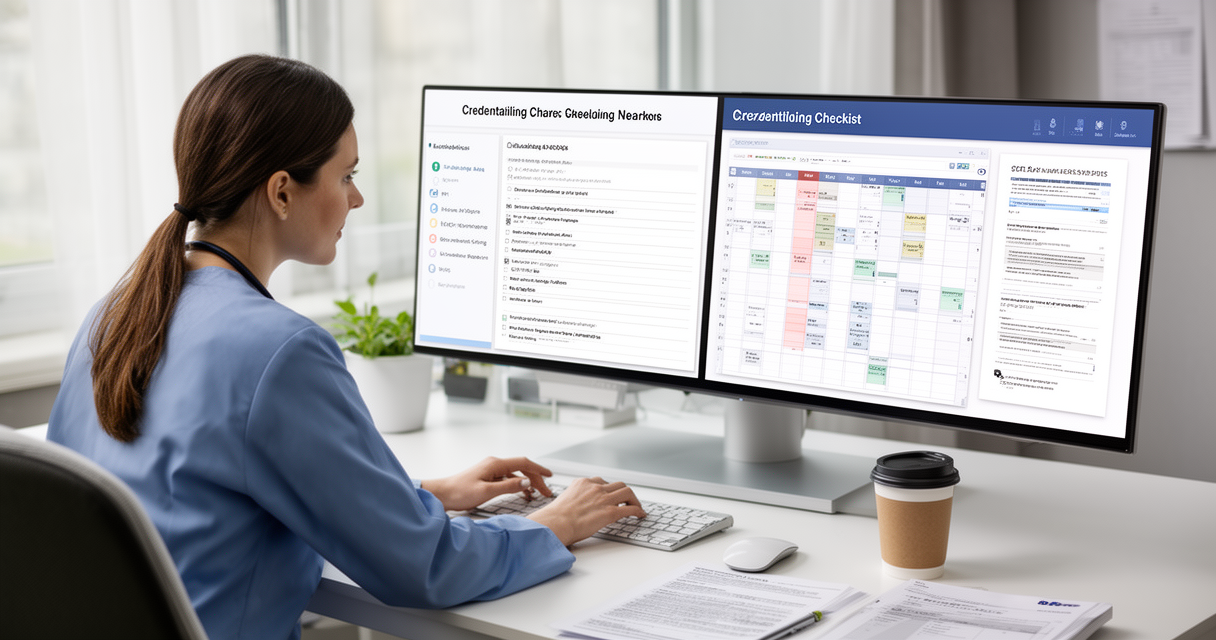
Choosing the wrong healthcare staffing software for your small agency doesn’t just cost you money — it costs your recruiters hours every week they should be filling shifts instead.
Your recruiters are spending half their week chasing credential expiration dates in spreadsheets, firing off texts from a separate tool, and reconciling schedules from yet another system. Somewhere in there, they’re supposed to actually fill shifts.
That fragmentation isn’t a workflow problem. It’s a software problem. And picking the wrong fix makes it worse.
Pick wrong and you’ll either pay enterprise prices for features a 10-person shop never uses, or lock into a platform that handles per diem beautifully but falls apart the moment you grow into travel. Both outcomes cost you time and money you don’t have.
For most small healthcare staffing agencies with under 15 recruiters doing per diem or mixed placements: Enginehire is the best fit in 2026 — purpose-built for credentialing plus per diem scheduling, fast implementation, mid-market pricing. Avionté Labor Edge is the second pick if travel nurse VMS connectivity is on your roadmap. Bullhorn is genuinely powerful but priced and structured for 20+ recruiters who already have a dedicated ops team.
Real pricing context, feature-by-feature comparison, and what recruiters running small healthcare shops actually say about all three — below.
What Small Healthcare Staffing Agencies Actually Need (And What They Don’t)
Not all healthcare staffing operations run the same workflow. Per diem, travel, and mixed-placement agencies have fundamentally different needs, and most software vendors gloss over that distinction when they’re trying to close a deal.
Per diem shops (filling day-of or short-notice shifts for SNFs, home health, and schools) live and die by scheduling speed and credential compliance. If a nurse’s CPR cert expired last week, that’s a liability exposure, not just an annoyance. The credential tracking and shift scheduling need to be in the same system — the moment they’re not, you’re generating manual reconciliation work.
One recruiter on r/recruiting described the reality plainly: “Credentialing especially eats up a ton of time. Recruiters are full desk here, so they’re sourcing, screening, credentialing, and managing clients all at once.”
That’s not a staffing problem unique to one agency. It’s structural. And the software fix has to address it structurally, not with another add-on integration that breaks quarterly.
The credential-scheduling coupling problem is expensive at scale. A practitioner familiar with per diem healthcare operations described it on r/recruiting: “Per diem healthcare ops is uniquely messy because credentialing and scheduling are tightly coupled but almost no tools treat them that way. Worked with an agency that consolidated most of this — the credentialing doc chase alone was costing them around 10 hours per week per recruiter.”
Ten hours per recruiter per week. On a five-person team, that’s a full-time position’s worth of labor going to document chasing.
Travel nurse shops, by contrast, need VMS connectivity — the ability to submit candidates through the Vendor Management Systems that hospital systems use to manage contingent staffing. That’s non-negotiable at real travel volume. But VMS connectivity matters a lot less if you’re filling per diem shifts for a network of local SNFs.
Implementation speed is underrated for small teams. A 6-month enterprise onboarding timeline isn’t survivable when you have 8 recruiters and no dedicated IT. If your software vendor needs 3 discovery calls before they’ll show you a demo, that’s a tell.
Enterprise staffing software is built for 100+ recruiter firms. Selling those platforms to a 5-person per diem shop is vendor theater. It looks impressive in the demo and punishes you in month two.
Quick Comparison: Enginehire vs Avionté (Labor Edge) vs Bullhorn
| Feature | Enginehire | Avionté Labor Edge | Bullhorn |
|---|---|---|---|
| Best For | Per diem / mixed small agency | Travel + per diem growth path | 20+ recruiters, MSP/VMS clients |
| Credentialing | Built-in (licenses, certs, CPR, immunizations, background) | Automated per assignment, Joint Commission audits | Native + add-ons |
| Per Diem Scheduling | Yes — receive, match, schedule in one system | Yes | Via third-party (Bluesky referred by Bullhorn) |
| Travel Nurse / VMS | Limited | Strong (confirmed by users) | Strong |
| Candidate Mobile App | Yes | Yes | Yes |
| Implementation Time | Fast (weeks) | Moderate | Weeks claimed; real cost overhead is high |
| Pricing | Contact-based, startup tier available | Approx. $750/month+ (quote-based) | Approx. $99–$165/user/month; full first-year for 5-person team exceeds $19,000 |
| Annual Price Increases | Not publicly disclosed | Not publicly disclosed | Approx. 9% per renewal cycle |
Pricing data checked June 2026 against pin.com/blog/bullhorn-pricing/ and avahr.com/avionte-pricing/. All three vendors require direct contact for final quotes.
Enginehire: Best Healthcare Staffing Software for Per Diem-Heavy Small Agencies
Enginehire was built for healthcare staffing specifically — not adapted from a general-purpose ATS and bolted together with a credentialing module. That distinction shows up in the day-to-day.
The platform tracks licenses, certifications, CPR, immunizations, and background checks with automated expiration alerts pushed to both the recruiter and the candidate. Shift request intake, candidate matching, and scheduling live in the same interface as the credential file. When a facility sends you a shift request, you’re not bouncing between three systems to confirm someone is actually compliant before placing them.
One practitioner on r/recruiting described their current stack after switching: “ATS/CRM/Scheduling: Enginehire (handles the database, SMS, and shift claiming). Credentialing: Modio (integrated so it updates candidate status automatically).”
That’s a lean, functional setup — Enginehire handling the operational core with a credentialing integration surfacing compliance status in real time. The important part is that the scheduling and candidate management aren’t fragmented from credential visibility.
Another agency operator who made the switch reported on r/recruiting: “We rolled out Enginehire last year and it has been a big step up from the patchwork of tools we were using before. The automation around timesheets and invoicing saved us a lot of manual work.”
Timesheet and invoicing automation matters more than it sounds. Manual reconciliation between scheduling records and billing is where small agencies lose hours every billing cycle. A unified platform that connects shift completion directly to invoice generation removes a whole category of error and labor.
Where Enginehire is weaker: Travel nurse VMS connectivity is shallower than Avionté Labor Edge. If your agency does significant travel volume or you’re planning to build a travel line, that gap will eventually matter.
Pricing: Contact-based with a startup tier. Not enterprise-scale costs. Specific quotes require a demo, but the positioning is mid-market, not enterprise.
If you’re running per diem for nurses, aides, or therapists serving SNFs, home health, or schools — and you’re still on a patchwork of tools — Enginehire is the obvious consolidation. It doesn’t try to be everything to every staffing model, and that focus is the point.
Avionté (Labor Edge): Best for Agencies Growing Into Travel Nurse Placements
Labor Edge is Avionté’s healthcare-specific platform, part of the Nexus family. The distinction matters: Avionté’s core product serves general staffing (light industrial, clerical, professional). Labor Edge is purpose-built for healthcare — per diem, travel, allied, and perm — with a separate compliance architecture built around healthcare credentialing requirements.
The compliance engine automates credentialing per assignment rather than per candidate. That’s a meaningful distinction for travel placements, where the credential requirements shift by facility, unit, and state license. The platform also supports Joint Commission audit documentation — a requirement for agencies working with accredited facilities that Enginehire doesn’t match at the same depth.
In January 2025, Labor Edge acquired CliniSight — a healthcare credentialing consulting firm specializing in Joint Commission auditing (Staffing Industry Analysts). That acquisition signals a deliberate move to own the compliance workflow end to end, not just the software layer.
VMS connectivity is confirmed by actual users. A recruiter on r/recruiting who uses Labor Edge for a compliance-heavy operation described the experience: “We use Labor Edge/ATS. It’s good for compliance. I do all the compliance, but also recruit. The compliance emails are all streamlined and I edit the docs, make them fillable. Send out a clean email. The clinicians can login and upload documents.”
That candidate-facing document portal is a real usability detail. Instead of emailing document requests and chasing uploads manually, clinicians have a login where they submit directly — and the credential status updates in the ATS automatically.
Where Labor Edge is weaker: Implementation overhead is meaningfully higher than Enginehire. More configuration, more setup time, more onboarding work. For a 5-person team that needs to be operational quickly, that matters.
Pricing: Quote-based, starting around $750 per month. Not the cheapest option, but not enterprise-scale either.
If you’re running travel placements alongside per diem, or you’re on a clear growth path toward travel-heavy volume and VMS client relationships, Labor Edge is more future-proof than Enginehire for that trajectory. Ask for a realistic go-live timeline — in writing — before signing.
Bullhorn: Powerful — But Probably Not for You (Yet)
Bullhorn is excellent software. Over 10,000 companies use it. The integration ecosystem covers 300+ connections. The healthcare edition has purpose-built credentialing. The Pro tier includes an AI assistant. If you’re running a 50+ recruiter firm with MSP and VMS relationships across multiple verticals, Bullhorn makes sense.
But the pricing math is brutal for small shops.
The starter tier runs approximately $99 per user per month. The ATS tier runs approximately $165 per user per month. Those per-seat numbers look manageable until you add implementation costs, Herefish (the automation layer you’ll need for anything sophisticated), analytics add-ons, and the first-year onboarding overhead. A full first-year cost for a 5-person team — including implementation, Herefish, and analytics — exceeds $19,000 (per pin.com/blog/bullhorn-pricing/, checked June 2026).
A long-term Bullhorn customer on r/recruiting was explicit about the economics: “Comparatively, I have noticed the cost-per-user account is about double or triple when comparing to other systems. Costs also increase 9% each contract renewal.”
That 9% annual renewal increase compounds. A $19,000 first-year spend becomes a materially higher number by year three.
There’s also a feature trap problem. Bullhorn’s per diem management and multi-location scheduling aren’t native strengths — the company itself refers customers elsewhere for those workflows. A recruiter on r/recruiting noted: “Bullhorn refers folks to [Bluesky software] especially for more tedious processes like per diem management and multi location scheduling.”
That’s an important data point. Bullhorn’s architecture was built for high-volume temp and perm placements, not per diem healthcare. If per diem is your core workflow, you’re paying Bullhorn prices for a platform that will then point you toward a third-party add-on to handle your primary use case. For the firms where Bullhorn does make sense — high-volume enterprise operations managing hundreds of requisitions — the best high-volume hiring software comparison for 2026 is worth reviewing before finalizing any platform decision at that scale.
No self-serve pricing. No free trial. Every conversation starts with a sales call. That’s not a complaint about Bullhorn — it’s just a sign of who they’re built for.
When Bullhorn makes sense: 20+ recruiters. Mixed healthcare and light-industrial volume. Heavy MSP and VMS client relationships. A dedicated ops person who can manage the implementation and ongoing configuration. Until you hit those benchmarks, the overhead doesn’t pay off.
Bullhorn’s sales team will tell you their platform scales from 5 to 5,000 recruiters. That’s technically true. It’s also true that a freight truck can get you to the grocery store. The question is whether the operating cost makes sense for your trip.
Our Pick: Which Healthcare Staffing Software Should a Small Agency Choose in 2026?
This is the decision framework, not a universal answer — because the right choice depends on what you’re actually placing.
Choose Enginehire if:
- Your core business is per diem placements (nurses, aides, therapists) for SNFs, home health, or schools
- You’re under 15 recruiters and need to be operational fast
- Your current pain is fragmented tools — separate ATS, scheduling system, and credential tracker that don’t talk to each other
- Budget is a real constraint and enterprise pricing isn’t viable
Choose Avionté Labor Edge if:
- Travel nurse placement is already part of your model or you’re building toward it
- VMS connectivity matters now or within the next 12 months
- You need Joint Commission audit support
- You have 8–15 recruiters and 3–6 months to onboard properly
Choose Bullhorn if:
- You’re at 20+ recruiters with genuine scale
- You have mixed healthcare and skilled labor volume, not purely clinical per diem
- Your clients are MSPs or large health systems requiring VMS compliance
- You have budget, an ops lead to manage implementation, and you’ve done the first-year cost math
Don’t choose Bullhorn if: You’re a 5-8 person per diem shop who just needs credential tracking and shift scheduling in one place. The cost difference versus purpose-built alternatives isn’t justified by the feature set you’d actually use.
Most small agencies asking this question are really asking “should I pay Bullhorn prices for Bullhorn features?” The answer, almost always, is not yet.
Frequently Asked Questions
Which healthcare staffing software handles credentialing expiration alerts automatically without manual chasing?
All three platforms offer automated credentialing alerts. Enginehire tracks licenses, certifications, CPR, immunizations, and background checks with proactive alerts to both recruiters and candidates. Labor Edge automates credentialing per assignment and supports Joint Commission audit documentation. Bullhorn handles it natively plus via add-ons. For small teams that need to be running in weeks rather than months, Enginehire’s implementation speed makes it the practical starting point.
Is Bullhorn worth the cost for a small healthcare staffing agency with under 15 recruiters?
Almost certainly not at that size. The entry tier runs approximately $99 per user per month, but the full first-year cost for a 5-person team — including implementation, Herefish automation, and analytics — exceeds $19,000. Real users on r/recruiting report the cost-per-user runs roughly double or triple competing systems, with contract renewals increasing approximately 9% annually. Purpose-built mid-market options solve the same core problems at significantly lower total cost.
Does Enginehire support per diem shift scheduling alongside credential tracking in one platform?
Yes. The platform is built specifically to receive shift requests from facilities, match and schedule compliant clinicians, and track credentials — all in the same system. Verified users on r/recruiting confirm it replaces separate ATS, scheduling, and credentialing tools with a unified workflow, including timesheet and invoicing automation connected to completed shifts.
What is the difference between Avionté and Labor Edge — and which is right for a small healthcare agency?
Avionté is the parent company; Labor Edge is Avionté’s dedicated healthcare staffing platform within the Nexus product family. Avionté’s core platform targets general staffing (light industrial, clerical, professional). Labor Edge is built specifically for healthcare — travel, per diem, perm, and allied health — with automated credentialing per assignment, Joint Commission compliance tools, VMS connectivity, and a candidate document portal. For a healthcare-only agency, Labor Edge is the relevant product, not Avionté’s general staffing platform.
Can a small healthcare staffing agency afford enterprise staffing software, or is there a purpose-built mid-market option?
There is: Enginehire. It’s designed specifically for healthcare staffing without the enterprise implementation overhead or per-seat pricing that makes Bullhorn difficult to justify at small agency size. Avionté Labor Edge sits in between — more depth than Enginehire for travel and VMS workflows, but requiring more configuration and onboarding time. Bullhorn markets a 2-week go-live, but the full first-year cost math typically doesn’t favor teams under 15 recruiters.
The Verdict for Small Healthcare Staffing Agencies
For most small healthcare staffing agencies in 2026: Enginehire is the pragmatic choice for per diem-focused operations, Labor Edge is the right call if travel placement is part of your model now or soon, and Bullhorn is a platform to grow into — not start with.
Before booking any demos, map two things: your actual staffing types (per diem, travel, perm, or mixed) and your current fragmentation points (where credentialing, scheduling, and invoicing live right now and where they break). That mapping determines which platform solves your real problem versus which one adds a new layer of complexity on top of the old one.
For I-9 compliance software that integrates with your credentialing workflow, /blog/best-i9-compliance-software-employers-2026/ is worth reading before you finalize any platform decision.
The best healthcare staffing software isn’t the one with the most integrations or the biggest logo. It’s the one your recruiters are actually using instead of a spreadsheet.